Pericles’ Funeral Oration

One of the great works of world literature is Thucydides’ History of the Peloponnesian War, the comprehensive account, compiled in the moment, of the twenty-seven-year “civil war” between Athens and Sparta.
The intellectual centerpiece of this work is Pericles’ Funeral Oration. Have you read it? In many ways, it’s our own⎯yours and mine⎯Magna Carta. It’s the first great statement of the ideals to which we aspire.
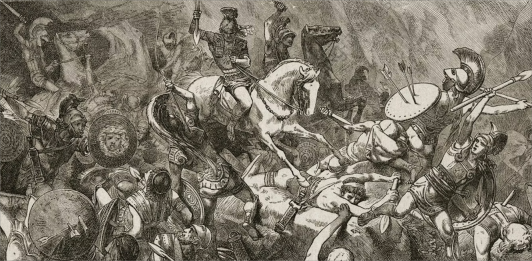
Pericles was the foremost figure of the Athenian Golden Age. During the second year of the war with Sparta, he was selected to give the speech at a yearly event like our Memorial Day in praise of those men of Athens who had given their lives in the military defense of the city. Everyone⎯women and children, and even slaves, as well as men—turned out for this occasion.
Pericles took the moment to praise not just the fallen heroes of Athens, but Athens herself, the city and all her citizens.
He contrasted the people of Athens, whose polity was free and open to the world, to their antagonists of Sparta who, great as they were and admirable as they may have been in many ways, lived by a code of exclusion, in a society closed off to the outside world and built around intensive and relentless discipline, where the individual male (and female as well, in her own way) was as much a soldier in an army as a citizen of a state.
Here’s how Pericles described the free citizens of his city:
I declare that Athens is the school of Greece. Moreover, I declare that each and every one of our citizens, in all the manifold aspects of his life, can be truly called the rightful lord of his own person and to act in this way, moreover, with unsurpassed quality and grace.
The rightful lord of his own person.
That idea, and that phrase, had never before in history been uttered, or even thought. Not in Egypt or Persia or Babylonia or Sumeria or Assyria, or among the wild tribes or the seafaring conquerors or the great horse warriors of the steppes.
The rightful lord of his own person.
That’s what you and I need to become. Beyond whatever gift or talent we may bring to the world, our job is to school ourselves and train ourselves so that no force, other than our own genius and our own ethical sense of community and responsibility to heaven, governs our thoughts, our actions, or our works.
DO THE WORK
Steve shows you the predictable Resistance points that every writer hits in a work-in-progress and then shows you how to deal with each one of these sticking points. This book shows you how to keep going with your work.

THE AUTHENTIC SWING
A short book about the writing of a first novel: for Steve, The Legend of Bagger Vance. Having failed with three earlier attempts at novels, here's how Steve finally succeeded.
NOBODY WANTS TO READ YOUR SH*T
Steve shares his "lessons learned" from the trenches of the five different writing careers—advertising, screenwriting, fiction, nonfiction, and self-help. This is tradecraft. An MFA in Writing in 197 pages.
TURNING PRO
Amateurs have amateur habits. Pros have pro habits. When we turn pro, we give up the comfortable life but we find our power. Steve answers the question, "How do we overcome Resistance?"
Sovereignty. As a people pleaser (of necessity in my younger years), I never imagined I could be “the rightful lord of my own person” until I took a course three years ago and the instructor told me I was lacking sovereignty. I didn’t even know I could have that. Her words set me free as I set out to discover who I really was underneath my programming. I need to make this the theme of my next story. Thank you, Steven ❤️
Veleka,
Inspiring. Cheers to you!
I’m also a recovering people pleaser, Veleka. Thank you for your comment. Let’s repeat this mantra together:
“The rightful lord of my own person”. This is us!
Thank you, Steven Pressfield!!
Thank you. A great Danish cartoonist, painter and social commentator Storm P. called one of his drawned vagabond characters Perikles.
http://copenhagenbykyhl.dk/435/
To be like a cat that the Divine grabs and puts where It wants at ease without fuss (taking this one from Agostinho da Silva).
The rightful and ethical lord of his own person isn’t easily swept up into the world’s nonsense. Hear! Hear!
Well done once again. Steven!
Stephen, Your writing speaks directly to my spirit. Thank you for sharing your gifts.
Steven, Your writing speaks directly to my spirit. Thank you for sharing your gifts.
Love it mate 🙂
When Cicero finished speaking, the people said: “ That was a great speech.”
When Demosthenes finished speaking, the people said: “ Let us march!”
And after Pericles finished speaking, the people said, “I’ll do what I please.”
Thank you so much dear Steve. Ah, what a core you ignite here. From the core, the results and the explosions, exponential or linear, depend. And if the core is like here, you, writing about those golden ages, mingling them with the lordship over our own destiny, then the explosion is tremendous. In other words, “yes, I could do that” vs. the orator who “yes, I find his idea beautiful”.
https://www.youtube.com/watch?v=yDT3_jVYAkI
My love to you, Diana, the team, all the people here.
And as for me, well, I have one control only (like Brian Tr. said): the control over the mind. And I must regain control now that I have trained it so much, for so many decades, chaotically. The End is just one or two numbers further to find and unlock the treasure chests.
Thanks. I needed to hear that today.
I love this so much that I’m going to pin this near my writing space. Thank you!
Last August, at the end of a family cruise of the Mediterranean, my family and I spent a few days in Greece. From the Acropolis, we could view the agora. I stood there with my adult daughter, who had majored in anthropology in college with a minor in ancient civilizations. I pointed to the agora and said, “Imagine that, Kim, we are looking at what is quite likely the birthplace of this idea we call democracy.” I wish I’d known more about Pericles’ oration, because I would’ve pointed out the cemetery and quoted him as you did. She would’ve been impressed with her dear old dad!
Well said Steve! Worthy of Pericles himself!
As a therapist once said to me after I’d related a recent incident of bending my life to the perceived needs of others: “Have you often betrayed your own spirit in this way?” That statement was a wake-up call.
Day 6 (catch-up) complete: I’m serving with my writing heart-good like Kris Karnos and Karen Wright, who want to learn new things about the world in an intelligent, euphonious way.
Day 14 complete: My CEO memo is:
Bill: You’re doing great, and we want you to continue to do so. From you, what most matters for our little enterprise here is that you put your butt in the chair, top priority, for at least a few hours per day, and work with focus. That’s all we need from you. Do that, and good things will happen. I’ll now leave you to it.
“The rightful lord of his own person.” So Powerful and Soul-Stirring!
The Heart of Self-Reliance, Self-Determination, and Sovereignty!
Or how Krishnamurti put it, “You have to be a light to yourself”. or “There is no guide, no teacher, no authority. You are the light to yourself.”
SP… I could be wrong… (often am) my understanding is PYTHAGORAS preceded Pericles and was known to say:
“NO MAN IS FREE WHO CANNOT COMMAND HIMSELF”
To me, that is even more stronger….
The rightful lord of his own person. would come after?
So, the statement/phrase: “That idea, and that phrase, had never before in history been uttered, or even thought. Not in Egypt or Persia or Babylonia or Sumeria or Assyria, or among the wild tribes or the seafaring conquerors or the great horse warriors of the steppes.”
Great stuff SP!! Thank you sir!
SP… I could be wrong (often am), but my understanding is that Pythagoras preceded Pericles and was known to say:
“No man is free who cannot command himself.”
To me, that’s even stronger.
“The rightful lord of his own person” would come after?
So, the statement/phrase: “That idea, and that phrase, had never before in history been uttered, or even thought. Not in Egypt or Persia or Babylonia or Sumeria or Assyria, or among the wild tribes or the seafaring conquerors or the great horse warriors of the steppes.”
Great stuff, SP! Thank you, sir!
I believe the government of Athens was fairly well organized in line with this belief. We can still work as hard as we can to keep sovereignty in matters under our control, but government in the USA, though undoubtedly the best in the West, has completely lost the plot.
The power in your last paragraph is so great that it should be on a monument. I’m keeping it to remind myself of the artist’s purpose. Thank you.
This is such a great concept to internalize. I’ve been going after my nails since I was a little kid, and have yet to break the habit. It’s my comfort the same way other people take up knitting. But the fact I feel so much shame if I so much as glance at my keyboard has to mean something. It’s probably not coincidental the habit bothers me most when I’m writing, and breaking it feels essential to the evolution of my soul.
Maureen, I,too, chose to annihilate my fingernails. I could not break the habit. After much soul searching, I uncovered some buried demons. Facing the truth and putting them behind solved my bad habit. I’m not suggesting you have demons. Nail biting was my way of dealing with not dealing with problems.
I wish you the best in your quest to overcome. If I could do it, I know you can.
Oh, I have demons! 🤨
You’re sweet to weigh in; I almost didn’t because it’s embarrassing. It’s also my holy grail, a portal to something — I’m sure of it. I happily accept your encouragement. Thanks!
One other thing I ran across recently makes me think this is a feature, not a bug…
https://www.instagram.com/reel/DTId2jWjjGs/
To be continued!
That line seems to be resonating with people. “Rightful lord of one’s own person.” In Greek, if you want, to hand off to your tattoo artist. Do I have this right, Tolis?
ο νόμιμος κύριος του εαυτού του
I’ve always got my radar tuned to try and see connections. What’s going on “over here” that resonates in some way with what’s going on “over there.”
This morning I’m working on my mother’s obituary. I’m talking to a cousin (whom I call a “grandbrother”) about what’s involved bringing Mom home to rest next to her father and her mother. I’m collaborating with my brothers and sisters in the way we do in these times.
So I see today Steve talking about Pericles’ funeral oration, and I think, “Yes. Of course. What else would it be?”
Synchronicity dear Joe! God, a wondeeful coincolidence.
You have the greek terms abaolutely right.
That would be a great tattoo, Joe. Condolences, it’s not easy to write a parent’s obituary.
So sorry to hear the news about your Mother. These things are just so hard.
‘Sending positive thoughts your way.
Thank you for your thoughts, friends. I’m comforted by this: my wife and I took Mom out for dinner the week prior. She was loving the Italian food, said yes to more bread, yes to the extravagance of tiramisu for dessert. She talked about being excited for all the plans she had lined up for the next couple weeks.
We dropped her off at her condo. I got out of the car to say goodbye. She said her last words and I said my last words, not knowing at the time they were “last words.” I remember those words and remember watching as she walked up the steps to her condo and knowing that she felt loved.
🩷
That’s about as perfect as things could be . . .
There are several other translations of Pericles’ speech. The Encyclopedia Brittanica’s Great Books, reads
I. “In short, I say that as a city we are the school of Hellas; while I doubt if the world can produce a man, who, where he has only himself to depend upon, is equal to so many emergencies, and graced by so happy a versatility as the Athenian.” (This is also the Wikipedia version)
II.”I say that Athens is the school of Hellas, and that the individual Athenian in his own person seems to have the power of adapting himself to the most varied forms of action with the utmost versatility and grace.”
Moreover, “We throw open our city to the world, and never by alien acts exclude foreigners from any opportunity of learning or observing, although the eyes of an enemy may occasionally profit by our liberality …”
Conclusion: Athenian freedom creates people who are capable of anything. Powerful, fearless, and honorable.
We should embrace, not fear the inclusion of “foreigners” in our national culture, they only make us stronger.
Thank you, Steven.
I needed that reminder. The freedom to be. So simple, and currently under so much threat. So necessary, and yet so fragile.
Day 15 complete: I set my writing hours, 07:30 – 11:00, and kept them.
I shared this post with my son who’s doing his PhD in Classical Languages with deep dive with Greek Mythology. He commented that “It’s overstating how great Athens was for individual rights. It was phenomenal if you were a citizen, but only a very selective group of people actually got that right. You had to be a native-born, free male Athenian to actually be a citizen.”
Day 16 complete: I ground out a draft pitch for next story ideas to a magazine where I’ve published previously.
Day 17 complete: My slate includes:
Now: the book “Saola Stories”
Next: editorial on immigrants and gun control; magazine piece on the love of trout
Someday: magazine pieces on Chosei Zen and the history of Coon Valley; book on the history of the Cedar Grove hawk trapping station.
Day 18 complete: My enemy voice says:
“Look around you – great books are written by highly intelligent people, and we know, and you know in your heart of hearts, that that ain’t you. And your mind is too old and dulled to be highly creative.”
Day 19 complete: I am committed to blocking my car radio today while on a road trip. I’ll listen to a good, feed-the-muse audiobook instead.
I have not honored my commitment for the past 8 days.
Did until day 11. The process is helping anyway.
Jumping back:
Day 11 complete: My self-discipline rule is: I will not waste hours watching the news or “distracting” myself with anxiety inducing content.
Day 12 complete: I got up before thinking.
Day 13 I will never ask my art to support me; I will support it by giving to it the chance it deserves. (maybe a little bit unspecific but I’m still working/ and thinking about it).
Day 13 complete: I support my work by giving to it the time, the planning and the dedication and focus it deserves.
Day 14 to be continue…
Thanks Steve, this exercise (creative Reset) is allowing me to see exactly where and how resistance is playing her cards. Is Helping me to change my mindset.
Day 14 complete: My CEO memo is take a choice, do the work, put words on paper, edit, and ship. Get it done. What doesn’t matter is all the BS resistance is constantly whispering, “kick the chihuahua”.
Today I do the best I can, I give myself the chance. Even a small step in the right direction is still a step.
Day 20 complete: I started the text of the chapter on “Martha” the captive saola.