To Pander or Not to Pander

I got a note this morning from Phil Britton about the Wednesday 8/6 post, “Empathy.” Phil writes, “I’d love to hear your take on how to balance this with the idea of ‘never play to the gallery.'”
Great question. I can see I haven’t been clear enough in the past couple of posts.
What I DON’T mean, and DON’T lobby for is “giving the fans what they want.” Forget that. The artist’s role is to lead. Nobody in Liverpool in 1962 was waiting for “Love Me, Do.” But when the Beatles released it, suddenly everyone went crazy.
“Give the people what they want” is legitimate, I think, if we’re debating where to locate our new frozen yogurt store in Williamsburg, Brooklyn. Answer: where there is no frozen yogurt store now.
But for you and me as artists, that concept is creative death.
Here’s what I DO mean when I say the artist must put herself in imagination in the place of the reader/viewer:
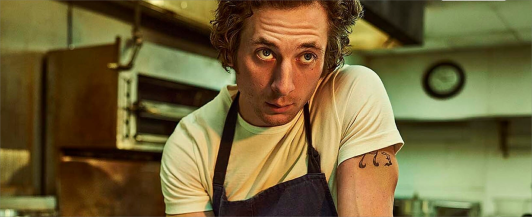
I was watching an episode of “The Bear,” Season Two. The opening scene took place in a hospital room. The character of Marcus was standing bedside with his mother or father (I forget which) in the bed. The director of the episode, Christopher Storer, had to decide where to put the camera for the opening shot. He decided to put it at bedside level, beside the bed, looking up past the side of the patient’s head, toward Marcus standing beside the bed.
How did he make that decision?
He knew what the scene was about. He knew what he wanted the audience to feel, to understand, and to take away from the scene. He asked himself, “What’s the best way to achieve this? Where should I put the camera? Behind Marcus? Outside the room looking in? What rhythm should the scene be in? Do we need music? What music? How should Marcus play the scene? Etc.”
Christopher Storer put himself in imagination in the place of the viewer. He thought, “This is the opening scene of this episode; the viewer won’t know where the episode is going. I have to set this scene up so that it makes sense, it hooks the viewer, it leads on into the next scene, and so forth. Where do I put the camera?”
That’s what I mean by empathy. That’s what I mean by being aware of who our readers or viewers are—what they know of the story, what emotions have hooked them, etc.
We’re not pandering to them or “giving them what they want.” They don’t know what they want. We’re giving them WHAT THE STORY WANTS, which equates to what (we hope) is the most interesting, most fun, most entertaining, most moving, most enlightening version of the ten bazillion possible versions we could give them.
That what I mean by creative/narrative empathy. It applies in all fields and to all of us all the time.
Hope this helps.
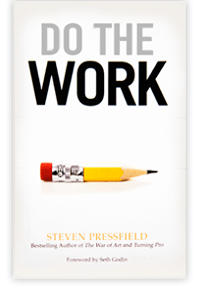
DO THE WORK
Steve shows you the predictable Resistance points that every writer hits in a work-in-progress and then shows you how to deal with each one of these sticking points. This book shows you how to keep going with your work.

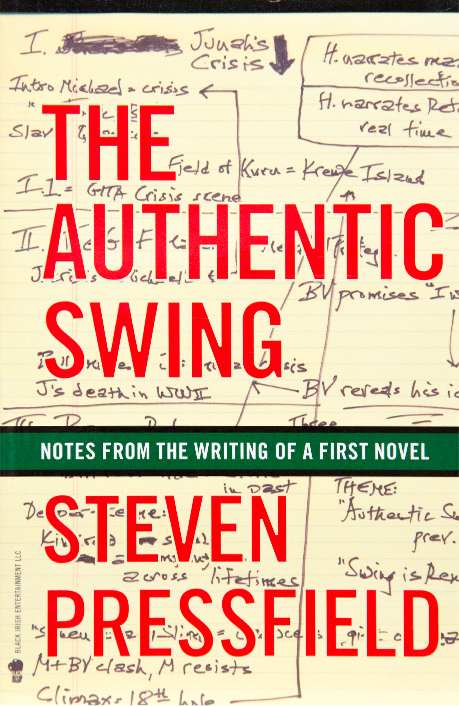
THE AUTHENTIC SWING
A short book about the writing of a first novel: for Steve, The Legend of Bagger Vance. Having failed with three earlier attempts at novels, here's how Steve finally succeeded.
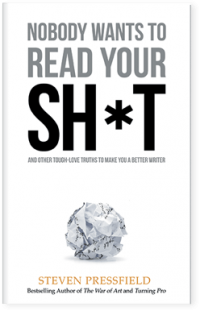
NOBODY WANTS TO READ YOUR SH*T
Steve shares his "lessons learned" from the trenches of the five different writing careers—advertising, screenwriting, fiction, nonfiction, and self-help. This is tradecraft. An MFA in Writing in 197 pages.
TURNING PRO
Amateurs have amateur habits. Pros have pro habits. When we turn pro, we give up the comfortable life but we find our power. Steve answers the question, "How do we overcome Resistance?"
Very helpful. Clarifying. Thank you.
While reading this, it struck me just how much art and creativity is about choices.
Thankfully, some days it’s easier to make those choices, rolling with it intuitively, than others.
But at its essence, individual creativity flows from our choices.
Thanks again.
This is indeed helpful. What the story or painting or music wants makes it true. As an artist, I feel a commitment to truth. Thanks, Steve.
Alrighty then! I am so grateful to the person who asked you for clarification and for your unforgettable answer. Decades of marketing input and output trained me to think the opposite way- know your audience to motivate them to action. Wow, all that changes today. Thank you!
After making my comment earlier, about an hour ago, I saw the 8/11/25 article in Variety by Steven J Horowitz about Taylor Swift’s new album. Taylor, the incomparable maker and marketer of music targeted to her superfans…. There’s a world-class example of the opposite of what you are saying in this post. I know, I know, eventually we get tired of being a target, right? Or aiming at one. This dichotomy would be a wonderful masterclass topic for you to teach!
Perfeitamente.👏
Ansel Adams once said, “The secret to taking a good picture is knowing where to stand.” To your point.
Good one, Jim.
Very good advise very well expressed.
Great post, Steve. Very helpful and clarifying. I enjoyed your use of The Bear episode and a directorial example rather than a writing one.
There’s about 11,000 views on this 5-minute video by Ken Burns, “On Story.” I’ve watched it about 1,000 of those times (okay, maybe just a dozen or two). In here, Ken Burns talks about something that resonates with the theme today. Steve says: “…the artist must put herself in imagination in the place of the reader/viewer.” And, “…being aware of who our readers or viewers are . . . what emotions have hooked them, etc.”
A minute into this video, Ken Burns says:
“Jean-Luc Godard said, ‘Cinema is truth, 24 times a second.'”
He pauses a beat and shrugs. “Maybe. It’s lying 24 times a second, too. All the time. ALL story is manipulation.”
“Is there acceptable manipulation? You bet. People say, ‘Oh boy, I was so moved… to tears… in your film!'”
“That’s a good thing? I manipulated that. That’s part of storytelling. I didn’t do it disgeniunely. I did it sincerely. I am moved by that, too. That’s manipulation.”
https://youtu.be/VlZYgPllKNU
Interesting share, Joe! Your thoughtful responses always provoke readers here. I am particularly moved how music affects viewers. A movie scene with the right music is so powerful!! I really enjoyed reading Steve’s take on the director’s perspective of shooting this scene. I have never heard of this show.
Thank you SO much for sharing my YouTube with Steve’s readers. I was happy to see Jackie subbed 🙂 Have a productive week everyone!
Oof. The Bear. Good show, Kate.
Love your music!
Kate, your music is beautiful and moving. You are spot on with networking/ connection. I sold my paintings at craft/art shows for a few years. Some days I felt like a chain store, but when there was connection, ahhh the feeling of sharing something with another was better than money.
Steve’s community here is special. Thank you Jackie & Joe!!
My personal opinion is that people do not like feeling like they’re being spoon fed beliefs or ideas. Pandering to your audience stinks of $$$ and fame-seeking behavior. Authenticity shines when it is in the right place at the right time with the right viewers. Is that the “luck” component everyone talks about? A music professor’s composition newsletter came to my inbox just before SP’s Writing Wednesdays. I found parallel ideas in the their messages. Check this out about networking in the music community:
“But here’s what made this networking so effective: he wasn’t “networking” at all. He was genuinely interested in the music, the performers, and the community. He asked thoughtful questions. He listened. He shared his own work when it felt natural.” Be natural. Genuine. Authentic to your writing voice. Keep going. Find the courage to share your work. Find intrinsic value in the work itself as SP says. Like a honeybee to a beautiful flower–bloom in your own way and perhaps it will attract the right listener, viewer, reader, etc. just some thoughts today…thank you Steve!
Kate, your comment about “like a honeybee to a beautiful flower” made me think about this bit from Ed Yong in his book An Immense World: How Animal Senses Reveal the Hidden Realms Around Us.
“If you took all the colors in all the flowers that were out there, and you asked … what kind of color vision is best at discriminating between these colors? What you get is an eye that’s basically almost what a bee has, an eye that is maximally sensitive to blue, green and ultraviolet.
“And you might think then that the bee eye has evolved to see the colors of flowers really well. That’s exactly the opposite of what happened, because the bee eye came first and the flowers evolved later. So the colors of flowers have evolved to ideally tickle the eyes of bees, and I think that’s a truly wondrous result.
“It means that beauty, as we know it, is not only in the eye of the beholder, it arises because of that eye.”
https://www.npr.org/sections/health-shots/2022/06/22/1105849864/immense-world-ed-yong-animal-perception-echolocation
Yeah, as to “networks” or webs of connection… this creative force or life force. It’s a flow, an exchange, that goes in both directions. In all directions. The Taijitu or yin-yang symbol reflecting that, maybe.
Your thoughts are full of depth, empathy, and curiosity!! Thank you so much, Joe! Now I am wondering what each creature sees…unique perspectives, aren’t they?
As always, its about balance.
Please…no more frozen yogurt stores in Willy B!
I didn’t read the previous post(s) on this, and will say, I was a bit confused by what you wrote here. I would say a better and less confusing way to frame your message would be to have stated that Christopher Storer identified first, where he wanted that initial camera angle to be from, in a way that conveyed how he wanted to the story to unfold, and in a way that he found most interesting and meaningful, and then couched this with how best to relate to and draw in the viewer without diluting the proof of his own personal storyline ‘scotch’.
“What the story wants.”
So much is said there!
The artist conveys The Story.
The Story is what we all connect with, and where the value is/comes from.
Empathy is WHAT THE STORY WANTS.
This is an active re-definition of a word I thought I knew.