Odysseus in the Wilderness #2

Let’s jump back into the Odyssey and see what else we can glean from Homer’s synopsis of his hero’s ordeal “in the wilderness.”
…. this song of the various-minded man, who, after he had plundered the innermost citadel of hallowed Troy, was made to stray grievously about the coasts of men, the sport of their customs, good and bad, while his heart, through all the seafaring ached with an agony to redeem himself and bring his company safe home.
Here’s my third takeaway from this passage:
… while his heart ached with an agony to … bring his company safe home.
Home.
All Odysseus wanted (and all you and I want on our passage) is to get home.
But what does “home” mean in mythic/legendary/metaphorical terms? It means that place where we belong. It means that sphere of action or contemplation that is our soul’s true epicenter. It means the Self we were born to be.

So why did we leave home in the first place? Maybe we were too young or too deluded to see it for what it was. Maybe we were cast out, as in last week’s post, by a crime we had committed or that someone had committed against us. Maybe “home” had become intolerable to us or wasn’t ready for the self we wished to become. Maybe we were summoned away to an emergency of our own or of someone to whom we were obligated, as Odysseus was by Agamemnon to the siege of Troy. Or maybe we just dreamt of “something better.”
And the end of all our exploring
Will be to arrive where we started
And know the place for the first time.
This is T.S. Eliot from Little Gidding, but it could have been Homer as well. For the Ithaca that Odysseus returned to after his ten years “in the wilderness” was not the same place he had left, nor was he the man he had been a decade earlier.
The point for me is that our odyssey, whatever form it takes, is not random. It’s not going nowhere. Herman Melville in White-Jacket wrote, “Life is a voyage that’s homeward-bound.”
Whether that’s true or not, or whatever meaning Melville intended, certainly our passage “in the wilderness” is a voyage whose ultimate aim is the discovery of our True Home, our authentic Self, the calling or love that is ours alone.
It’s interesting to me that the way Homer describes Odysseus’s ordeal is not in terms of physical torment, as, say, Prometheus bound upon his Rock or Sisyphus toiling on his hill. Rather, the poet phrases it as a passage whose pain comes from being far from home.
… was made to stray grievously about the coasts of men, the sport of their customs, good and bad …
If you’ll forgive me for digressing to Liverpool in 1965, here are a few verses from Gerry and the Pacemakers that I’ve always hoped to be able to say for myself.
So ferry ‘cross the Mersey
Cuz this land’s the place I love
And here I’ll stay
And here I’ll stay
Here I’ll stay.
DO THE WORK
Steve shows you the predictable Resistance points that every writer hits in a work-in-progress and then shows you how to deal with each one of these sticking points. This book shows you how to keep going with your work.


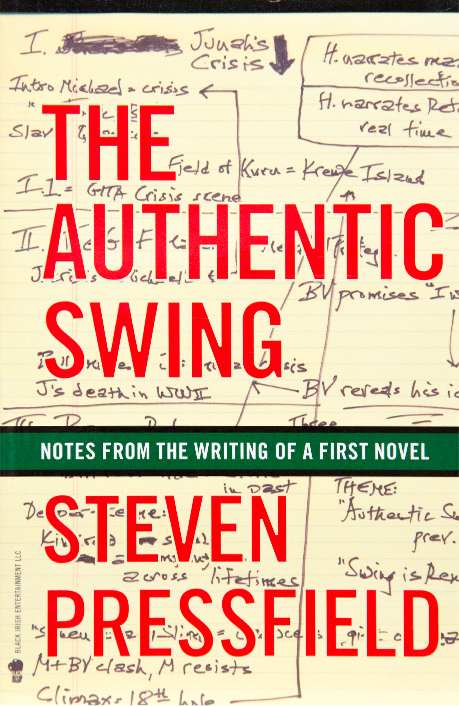
THE AUTHENTIC SWING
A short book about the writing of a first novel: for Steve, The Legend of Bagger Vance. Having failed with three earlier attempts at novels, here's how Steve finally succeeded.
NOBODY WANTS TO READ YOUR SH*T
Steve shares his "lessons learned" from the trenches of the five different writing careers—advertising, screenwriting, fiction, nonfiction, and self-help. This is tradecraft. An MFA in Writing in 197 pages.

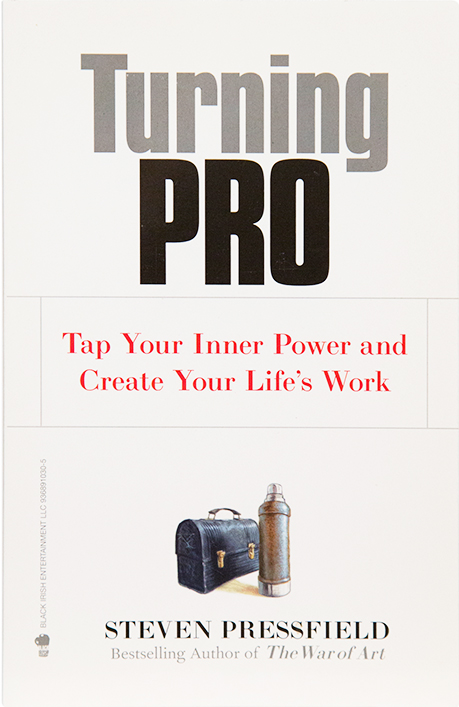
TURNING PRO
Amateurs have amateur habits. Pros have pro habits. When we turn pro, we give up the comfortable life but we find our power. Steve answers the question, "How do we overcome Resistance?"
Powerful Steve, and thank you. There is something worse than the wilderness. It’s dropping your arms and running away or never attempting the adventure.We won’t be the same. That’s the goal, finding the truth to become our Self. It’s not just finding, sometimes it’s discarding old ways or false beliefs we thought were truth. Challenging, you bet. Worth it? Absolutely.
I agree with your point that this is not random.
Two quotes came my way this week.
All men should strive to learn before they die what they are running from, and to, and why.-James Thurber
The best way out is always through.-Robert Frost
Remember: we are not alone in the wilderness. Wishing safe, productive journeys this week to all.
Fantastic, Steve! These “wilderness” posts are really resonating and hitting home. I’ve been in the wilderness a long time, and this post gives me hope. Thank you.
In the weeks and months after my life imploded (and as of this series I’m now calling it that time the wilderness), I surveyed the wasteland (what I called it then) and wished for a class on how to make a life transition. I quickly found one. As you pointed out, Jackie, I was no longer alone. My new friends pointed me home with this: “Who you are and what you love doing is not a mistake.”
Your friends are right. It’s not a mistake. The mistake is in not following through with the journey.
I like the idea that ‘home’ is not a location as much as an insight. When one finds their authentic self, home is ever-present.
Obviously, the inverse is true as well, until one finds oneself–no location works. No matter where we are, we are still there…
The phrase “comfort in one’s own skin” or Pasqual’s “…ability to sit quietly in a room alone.” identify the same condition Homer writes about 3,000 years ago.
This thought just hit me. If Homer describes the same condition Steve is writing about now–that kinda blows to hell any and all idealistic ideas I’ve had over the years. There is nothing new under the sun. The battle is always on the inside. External enemies are mostly distractions from the true fight of finding one’s Self.
bsn
Brian, I’m sure I don’t need to identify this quote: “We did not fight the enemy.; we fought ourselves” — not merely against others who were nominally on our side, but each of us fighting our own selves. The eternal question– whose side will each of us fight on, the angels’ or the demons’? (And are we wise enough to tell the angels from the demons?)
Curiously enough, for no reason at all, Ferry ‘Cross the Mersey was stuck in my head the other day. Dare I suppose that the same Muse that inspired Sensei to write this might have brushed past me too? (Of course not — but it is a pleasant thought.)
And since we mentioned Jocko not too long ago: I was listening to a podcast with Jordan Peterson and Daniel Greene, who wrote 48 Laws of Power among many others. Despite coming from entirely different realms, Jocko, Jordan, and Sensei share a lot of points. Jordan said this, but it could easily have come from either of the others: “Discipline is critical for creatives, who need to force themselves to focus on whatever it is they need to do, because their nature is to go off chasing butterflies again” — not a direct quote, but the gist is accurate.
(I trust that is relevant enough to this community that you will forgive me the diversion.)
Definitely relevant. Those damn butterflies are so beautiful!
I’ll try to find that podcast. I really enjoyed the two I heard with Jocko and JBP. Same principles, same conclusions from vastly different experiences. My butterfly net is way too close for comfort on many days…
bsn
Non,
I no longer believe in coincidence. I am not educated enough to understand or even begin to articulate ‘quantum entanglement’–but just those two words together more accurately describe what I believe. Real stuff exists that we, currently, cannot measure nor detect. What if Angels and Muses (and Demons for that matter) are eventually ‘discovered or identified’ as ‘energies’ on a particular frequency?
Who knows? I certainly do not, but I have chosen to not be wedded to the materialistic view.
bsn
Hi, Steve…
Apologies if you already know this, but I didn’t get this post by eMail today. I have your site bookmarked, but seeing so few comments when you usually have several makes me wonder if you realize there’s a problem with whatever sends your eMails out.
Maureen
Likewise.
Home. In my journey, I’m discovering that the wilderness is disconnect from understanding. It’s the battle field of different points of view that refuse to collaborate into something new. Then time runs out. And the only change is mourning and transformation of the same place. The last scene of gangs of New York… where that cemetery changes in fast forward mode. Same location and yet huge journeys toward home.
In the Bhagavad-Gita, we learn that Krishna implores Arjuna to kill the enemy on the other side of the battlefield. Arjuna resists, seeing on the other side of the field those he recognizes as “friends, kinsmen, teachers.” Steve noted (in this post) that:
“The names of the individual warriors among the enemy (and the Gita recites them all in a lengthy list) can be translated in Sanskrit to read not just as personal names, but as qualities of human vices–mortal failings common to us all.
The names of these foes read like this:
“Fear.”
“Arrogance.”
“Complacency.”
“Self-doubt.”
“Laziness.”
“Disrespect for others.”
“Impatience.“
It was those vices that Krishna is urging Arjuna to dispatch.
When I read the story of the Odyssey and the part where he kills the suitors who’ve been pursuing his wife (and her conspiratorial maids), I wonder about what metaphor I can derive from this.
Ultimately, it’s the Journey itself that enables us to recognize Home when we finally arrive there….
I’m spotting so much “quantum entanglement” right now – love that term!!
And must stop chasing so many butterflies.
When Jesus commanded “Satan, get thee behind me!” I wonder if he meant Resistance
Hello Steve,
I have been so fond of the wilderness ever since i was a kid, i truly enjoyed these fine collection of words from you.
Regards,
Trisha
I love this web so much it is really great web i love this web so much