The Business We’ve Chosen

Someone put a bullet through his eye. No one knows who gave the order. When I heard it, I wasn’t angry; I knew Moe, I knew he was head-strong, talking loud, saying stupid things. So when he turned up dead, I let it go. And I said to myself, this is the business we’ve chosen.
If you recognize this speech from The Godfather II, you know it was spoken by Hyman Roth (Lee Strasberg) to Michael Corleone, played by Al Pacino. Roth delivers it with barely restrained fury, sensing that he is about to be betrayed by Michael and aiming to deliver a hardball point to his rival, who is a generation younger and who, as Roth clearly knows (though he doesn’t say it), is the man “who gave the order.”
Here’s the passage in full (written by Mario Puzo and Francis Ford Coppola):
There was this kid I grew up with; he was younger than me. Sorta looked up to me, you know? We did our first work together, worked our way out of the street. Things were good, we made the most of it. During Prohibition, we ran molasses into Canada… made a fortune, your father, too. As much as anyone, I loved him and trusted him. Later on he had an idea to build a city out of a desert stop-over for GI’s on the way to the West Coast. That kid’s name was Moe Greene, and the city he invented was Las Vegas. This was a great man, a man of vision and guts. And there isn’t even a plaque, or a signpost or a statue of him in that town! Someone put a bullet through his eye. No one knows who gave the order. When I heard it, I wasn’t angry; I knew Moe, I knew he was head-strong, talking loud, saying stupid things. So when he turned up dead, I let it go. And I said to myself, this is the business we’ve chosen; I didn’t ask who gave the order, because it had nothing to do with business!
When you and I set out to follow our artistic or entrepreneurial dreams, we embark on an enterprise whose outcome is unknowable and whose passage is dangerous, cruel, capricious, massively difficult and almost totally without justice in terms of reward-for-risk-and-sacrifice. This racket of ours is life and death, take no prisoners.
But always remember: Nobody dragooned us. No one put a gun to our head. We entered the arena of our own free will, and we must deal with every aspect of it—the parts we hate as well as the parts we love.
This is the business we’ve chosen.
DO THE WORK
Steve shows you the predictable Resistance points that every writer hits in a work-in-progress and then shows you how to deal with each one of these sticking points. This book shows you how to keep going with your work.

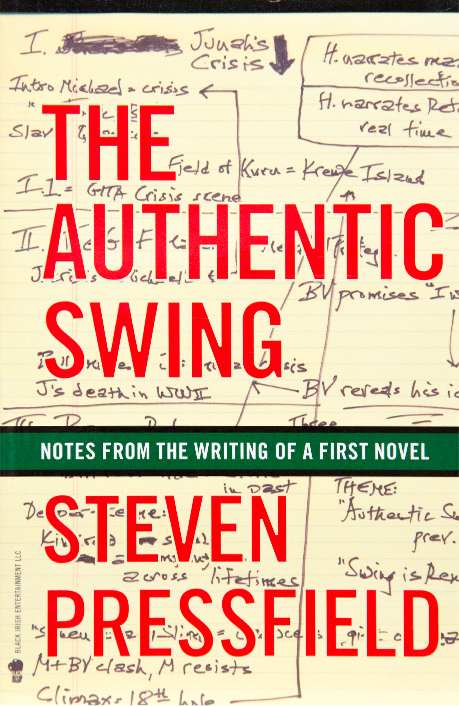
THE AUTHENTIC SWING
A short book about the writing of a first novel: for Steve, The Legend of Bagger Vance. Having failed with three earlier attempts at novels, here's how Steve finally succeeded.
NOBODY WANTS TO READ YOUR SH*T
Steve shares his "lessons learned" from the trenches of the five different writing careers—advertising, screenwriting, fiction, nonfiction, and self-help. This is tradecraft. An MFA in Writing in 197 pages.
TURNING PRO
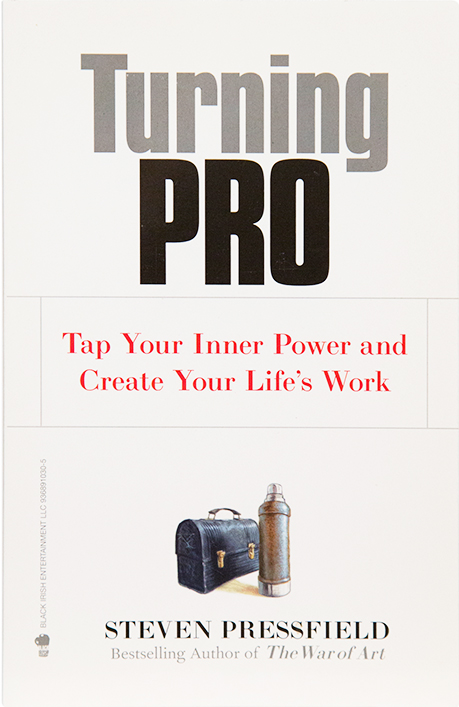
Amateurs have amateur habits. Pros have pro habits. When we turn pro, we give up the comfortable life but we find our power. Steve answers the question, "How do we overcome Resistance?"
Thank you, Mr. P! Now I have to watch it again, then watch the first one, because once I start, I can’t stop. And you’re right: like embarking on a creative journey in any other art form, you have to go in knowing this: no one is holding a gun to your head except your own inner Don Vito! Well, technically, your inner Luca Brazzi!
This is so true! Whenever I have a moan about this or that to my very lovely wise mother she reminds me that I chose my life. I decided to live the way that I do and that if I don’t like it I can always change it. So feeling grateful today. And like Joe, I’ll probably watch these wonderful movies again. Thank you Steve
So true. The one time I bitched about the money, a colleague set me straight: “No one twisted your arm”. I’ve never complained again.
Hmmm… I agree with the premise but your example is on the extreme side. Being a Jew-like you Steve- I have carried enough crap about our folks. Yeah, we’re good at everything, even being mobsters. Let’s talk about another ‘business.’
Ben May
Orlando
Excellent. Thank you.
Interesting way to take truth, rub our face in it, and to stop us from our whining, so we can get back to business. Thanks.
This great Steve, thank you for being so committed to the mission of helping other writers. We so need this kind of insight and support. Many blessings.
Puzo’s work as instructive to our craft and philosophy as writers is a helluva lesson, Professor. Reminds me of Vermont C. Royster’s essay in the WSJ about “this accountability of good and well-intentioned men.” We chose this craft and we must accept what comes with it.
Love this!
My editorial colleague and I trade this line all the time when dealing with authors.
Liked this a lot – thanks, Steve! It also makes me think about how we don’t choose just once full stop. Life happens and then we get to make that choice again and again. Life’s kinda charming that way!
I didn’t choose this business, it chose me.
Steven Pressfield and Tom Vandel are both EXACTLY RIGHT.
IF I could turn it off and on like a light switch, that would be one thing. I can’t. It’s a blessing – and, at times, a curse. Beyond that, I’ve given up trying to figure out the nature of it. It is what it is – a part of me.
Here’s another facet of “the business we’re in.” Isabel Allende, from today’s LitHub mailer. I liked it.
Thank you always for being here dear Steve.
Ah, it is a pessimistic view. We chose a game with possibilities, and this one -the book for me- is hands down of very, maybe extremely, low-success-possibilities.
I wish writers were paid like other professionals. Steady paycheck, for investigating the self and the world in their art. What would had happened then? Hmm. The first thing that comes to mind, is that there would be much lower numbers of dangerously “resigned” people in our societies. They would have found their path.
I longed for, and tried for, and stressed for the book for six or seven years. I lost count.
Now I’m ending it. At last.
And after that, no certainty and no guaranteed possibilities in my favor. To compensate for my struggle of 7 years and the things I didn’t do for my economic life because I chose to sit on the chair trying-and-failing to write a few words for the people, I would have to gain at least sixty to one hundred thousand euros in a simple estimation. Just for a basic livings’ compensation for those wasted years. And of course you hope for much, much more to be able to be a real artist.
But I heard those who even their publishing houses cut communication with them once they published their book, let alone gained nothing.
Great.
We are fools.
I’m also so alone. No team, no nothing on this. Just you, on the other side of earth. And a good friend -one of those who choose much, much higher possibilities’ rates- who wants -no, desires- to read my book. I would trust that one friend, he is a machine. And a couple of acquaintances who feel happy when I say I write, when we meet once in a while.
Others of course mock and laugh. Brilliantly, spectacularly.
I also think that some were influenced to deprive me of my generations’ great inheritance because of the way I followed, which is not the safe-and-go way, but the way of the wanderer. The exile, the Ranger.
We are fools. We place our hopes on a roulette. At least, we turn it around and round like the wheel of Dharma or whatever that’s called.
On the other hand, you said it yourself: we have no competition because if we finish the work, we must know that the other 99,9999% did not finish it, so we are automatically winners – or to phrase it better, the only lottery ticket in the picking box. So this is positive. By the way, this makes me wonder if we should always seek new fields and not ones that are already “known and working” in our art. It’s like, in a game of low possibilities, also sharing the winning pie with many others. Everything diminishes.
A, but I fulfill a great dream. All other dreams collapsed.
My love to you, Diana, the team, the friends.
I’m writing.
Sisyphus – If you hadn’t been writing all those years, what would you have been doing? Writing keeps me out of trouble, that’s what I tell folks. And it strengthens the brain and makes you smarter, which is true for you judging by your message.
Thank you for taking the time to read it all, dear Tom. Yes, the awareness is widening. Also the challenges make me better. One of the toughest ones I learned, and I think I learned it a lot, is the ability to keep out of the brain annoying distractions which can be fatal for the creative brain -and not only the book of course, but the whole life. So I can say with certainty what I said was just a point of view, with some important notes inside. Let’s go, we have a world to conquer.
Another reminder of Life In The ARENA, baby! Grateful for your lived wisdom, brother!
Thanks for the reminder Steve!
It helps me shut up and march on like a good soldier. Do the work, whether it be dishes, the yard, or the words. Bravo, Semper Fi.
“The business we’ve chosen”
I like this more than “the business chose me”
The later is when resisitance has much more to feed on