The Code of the Entrepreneur

I’m borrowing (again) from my entrepreneurship guru, Dan Sullivan. Dan has crystalized the statement that every entrepreneur makes to him or herself, whether she does this consciously or not.
It’s the entrepreneur’s code, the independent businessperson’s declaration of principle:
I will expect no remuneration until I have created value for someone else.
Let me repeat that:
I will expect no remuneration until I have created value for someone else.
We write a book. It’s got to sell. It has to “create value” for the reader. Otherwise, we’re not artists, we’re artistes.

You and I must remember always that art is a transaction. The viewer or reader or gallery-goer brings to the table something precious. Her time. Her attention. She may even actually pay money. In return, you and I must deliver something—an image, a song, a story—worthy of our reader or viewer’s time and attention.
This is not easy. Why are there forty million songs released every year but only six hundred that anybody actually remembers? Because it’s hard!
Why do I cite this Entrepreneur’s Code? I do it to get our feet planted firmly on the ground. So that you and I as musicians and filmmakers and video game designers can operate in the world as it really exists—and not in some “artistic” fantasy.
I will expect no remuneration until I have created value for someone else.
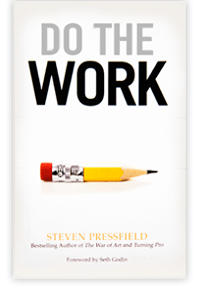
DO THE WORK
Steve shows you the predictable Resistance points that every writer hits in a work-in-progress and then shows you how to deal with each one of these sticking points. This book shows you how to keep going with your work.

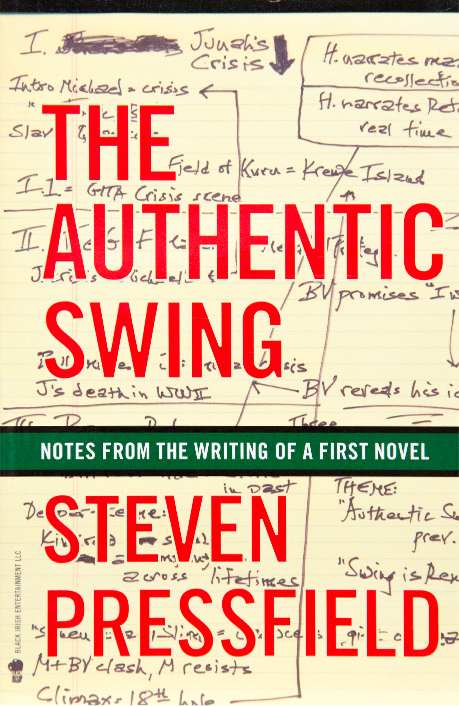
THE AUTHENTIC SWING
A short book about the writing of a first novel: for Steve, The Legend of Bagger Vance. Having failed with three earlier attempts at novels, here's how Steve finally succeeded.
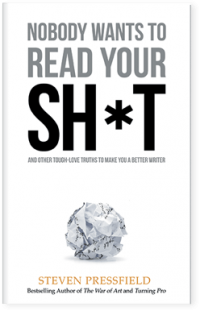
NOBODY WANTS TO READ YOUR SH*T
Steve shares his "lessons learned" from the trenches of the five different writing careers—advertising, screenwriting, fiction, nonfiction, and self-help. This is tradecraft. An MFA in Writing in 197 pages.
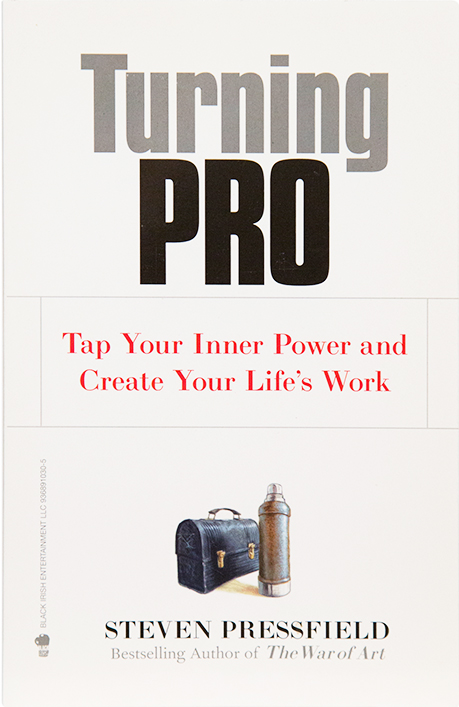
TURNING PRO
Amateurs have amateur habits. Pros have pro habits. When we turn pro, we give up the comfortable life but we find our power. Steve answers the question, "How do we overcome Resistance?"
Magnificent message.
One added aspect I tell myself is that I must also move them. For a novel or screenplay, they are not there for information. They want to feel.
Thank you.
This. We connect through emotions. However, sharing information is part of that. It is both connection and transaction, and its terribly difficult to nail that balance in any relationship.
The same with songs. The more the song makes you feel, the more the listener wants to posess it for future listening/raising the feeling again.
I guess I’m an artiste then because I believe in creating something that’s true to myself, rather than creating something for a target audience and giving them what I think they want, even if there’s nothing of me in it at all.
If I create something with all of me in it, and I put all of myself into it when I made it, and it’s the absolute best I could do and there was no way I could possibly make it any better (without ruining it) ~ and nobody finds any value in it, then gee I guess I’m no artist.
I guess that’s why I’m no entrepreneur (and therefore not an artist as this series defines it). Like Jerry Mulligan said in American in Paris, we’re not manufacturing paper cups (but there’s a lot of value in paper cups; people can drink out of them ^_^)
I have an art studio and enjoy painting almost every day; also write and play piano. I am artistic and have long considered myself an artist although I have never tried to sell my art. Dictionary definition for artist is, ‘a person who produces paintings or drawings as a profession or hobby’. Yup, I’m an artist, lol a poor artist!
I browsed your website, Jill. You’re good.
Thank you so much dear Steve.
I remember mr. Jim Rohn from the old times saying these 2 things:
1.) “Why we get payed? We get payed to bring value to the marketplace.”
Thankfully my book has a great value to give to the people. I don’t know when I’ll manage to end it, and if it will be excellent enough to be noticed by the market (please consider this thought for a moment), but I know its value as objectively as I can.
Now, this is the 2nd thing he said:
“You say, I payed 20 dollars for this book. No, that’s not true! You payed 20 dollars for the pages, the ink, the publishing house, the marketing of the book, the intermediaries etc. The ideas in the book are FREE.”
We can think of that a lot, and let me add a hope.
The hope that the ideas on our books will be infinitely higher than the cost of the book.
Cost vs Value. He also talked about that.
From the middle of my war zone, I send love and hope to you both and everyone <3
Disney told those that worked with him, “You build it for them.”
That’s the intention, the starting point. That’s where the connection comes.
We reach from our core to touch and connect with theirs.
The artist/entrepreneur works from this intention to connect and add value. Is there any better way to do good in the world?
Excellent! If I remember that while I’m writing, my ms is so much better. It keeps me on track.
I like this. And it seems the operative word is “attention.” If everything is a process — a river flowing — then flow of attention must be the principal currency. Okay, and then other things piggyback on that principal, be they money, love, or some other exchange in things of value.
Something I like about coming in here: reading Steve’s post, then considering if I have anything of value to add. I’ll look around, look over my shoulder, look for something else I’m seeing or hearing or reading, seeing if there are any connections that resonate with Steve’s theme of the Wednesday. So, on “value”…
I’m reading the CM Kushins biography, Cooler than Cool: The Life and Work of Elmore Leonard. Kushins just opened Chapter 13, “High Noon in Detroit: 1980 to 1982,” and he quotes Dutch:
“A reporter asks what it’s like to ‘achieve success finally at your age,’ wondering if I resent the fact that it’s taken so long in coming. What I resented was the question. I told the young but balding interviewer that I’ve never considered myself ‘unsuccessful’ or that being on a bestseller list had anything to do with it. My job is not to sell books, it’s to write them.”
Another good line from that biography. Kushins is talking about Leonard at one point having two completed novels in with Bantam. He’d completed them two years prior, but they were dragging their feet on getting them published and in bookstores. He’d completed his next novel, and told his agent with some sarcasm, “I’m finishing this one in a week and should have it in your hands, but I’m sure anxious to send it to Bantam and see it die there on some shelf.”
Dutch added: “I write to be read.”
One more from Dutch, on “value.” He’s writing to his son Chris, telling about his publisher sending his manuscript for Split Images out to established authors, seeking blurbs:
“He first shared with Chris: ‘Arbor House sent Split Images to John D MacDonald, hoping to get a jacket quote from him,’ and he said, ‘Are you ready?'”
“MacDonald wrote: ‘Elmore Leonard’s Split Images is strong and true and persuasive. Leonard can really write. He’s astonishingly good. He doesn’t cheat the reader. He gives full value.'”
I will expect no remuneration until I have created value for someone else.
I believe in creating something that’s true to myself, rather than creating something for a target audience and giving them what I think they want, even if there’s nothing of me in it at all.
These two lines stand out. The word value means the quality of a thing or beliefs or standards. For me, both definitions must line up.
I worked retail for a number of years. A manager said, “Make the customer buy things she didn’t even know she wanted.” I handed in my resignation and never worked retail again.
Our world is full of junk. It will never be my goal to convince someone to purchase beyond their means or to add to the heaps of garbage on this planet.
As for what makes a best seller, a hit song, etc., if anyone knew how to guarantee that magic why would any of us keep trying? May we all do our best to add value, quality and standards.
Despite transitioning from F/T teaching to sub-teaching (as part of the means by which I support my Art), I still carry my signed copy of Dan’s “No B.S. Time Management for Entrepreneurs” book I picked-up in my travels, occasionally reading passages to students when the lesson plan runs short—Tell me, Steve, back in ‘04, Dan had a strict “no cell phone” policy, as he felt “if they can’t find you, they can’t interrupt you”: Was curious if he’s been able to maintain that policy in the twenty years that have passed since then?
Caia na real! Evite ser negativamente pretensioso.
👍👏 Obrigado.
“We write a book. It’s got to sell. It has to ‘create value’ for the reader.”
What number of copies sold makes you an artist?
Interviewer: Do you hear the spirit of jazz in pop today?
Quincy Jones: No. People gave it up to chase money. When you go after Ciroc vodka and Phat Farm and all that shit, God walks out of the room. I have never in my life made music for money or fame. Not even Thriller. No way. God walks out of the room when you’re thinking about money. You could spend a million dollars on a piano part and it won’t make you a million dollars back. That’s just not how it works.
Good one, Sam.
Better to busk and get a total of $5.50 from 3 passersby
than to post on insta and get a hundred likes.