Glaukos and Sarpedon

[I’m starting (actually I started it a couple of weeks ago) an informal series on Instagram, where I will be recommending books on leadership—primarily military but also corporate, nonprofit, and so forth. The first book, inevitably, will be the Iliad. Doing some preliminary research I stumbled onto this post from nine years ago, before we were even doing “Writing Wednesdays.” I bring it back today, just for the literary greatness of the passages quoted from Homer. I hope our readers judge it worth their time and attention.]
Was there a greater war story, ever, than Homer’s Iliad? It’s almost a crime to call the Iliad a war story, by so many magnitudes does it transcend that and every other genre. What works of literature stand beside it? The Bible. The Bhagavad-Gita. The collected works of Shakespeare. Not much else.
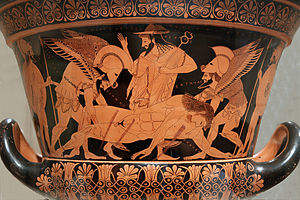
The death of Sarpedon, from the Euphronios krater, 515 B.C.
I took a full-semester course in the Iliad in college. I got a D. I wish I could take that class over, because, after a few decades in the trenches of the storytelling craft, I’ve acquired a keen appreciation for the challenges that Homer faced in conceiving and composing this epic—and for how masterfully he solved them.
Today let’s consider one item only: minor characters.
The architecture of the Iliad has heroes stacked in tiers, if you’ll forgive a term from this season’s presidential debate coverage. As Homer’s champions duel each other before the walls of Troy, third-tier heroes (Agenor, Teukros, Antiphos) fall to second-tier heroes (Odysseus, Diomedes, Aeneas), who in turn are slain or bested in other ways by first-tier heroes (Hector, Achilles).
Glaukos and Sarpedon are third-tier heroes, but look at the speeches that Homer gives them (translation by Richmond Lattimore):
SARPEDON: Glaukos, why is it you and I are honored with pride of place, the choice meats and the filled wine-cups in Lykia, and all men look on us as if we were immortals, and we are appointed a great piece of land by the banks of the Xanthos, good land, orchard and vineyard, and ploughland for the planting of wheat? Therefore it is our duty in the forefront of the Lykians to take our stand and bear our part of the blazing of battle, so that a man of the close-armoured Lykians may say of us, “Indeed these are no ignoble men who are lords of Lykia, these kings of ours, who feed upon the fat sheep appointed and drink the exquisite sweet wine, since indeed there is strength of valour in them, since they fight in the forefront of the Lykians.”
Sarpedon was the son of Zeus and Laodameia; he and Glaukos were princes of the country of Lykia in Asia Minor. They were allies of the Trojans; they had rallied to the aid of Priam and fought beside Hector in defense of Troy. The root glauk- in Greek means “gray,” thus “Glaukos” means “gray-eyed.” Here is that hero, on the battlefield, answering the challenge of the Greek champion Diomedes:
GLAUKOS: High-hearted son of Tydeus, why ask of my generation? As is the generation of leaves, so is that of humanity. The wind scatters the leaves on the ground, but the live timber burgeons with leaves again in the season of spring returning. So one generation of men will grow while another dies. [Glaukos goes on to cite his descent from Bellerophon, who among other feats captured and tamed the winged horse Pegasus and rode him when he slew the monster Chimera]. But Hippolochos begot me … sent me to Troy and urged upon me repeated injunctions, to be always among the bravest, and hold my head above others, not shaming the generation of my fathers, who were the greatest men in Ephyre and again in wide Lykia.
Sarpedon, in the end, would be slain by Patroklos, prompting Hektor to enter the fray to save his ally’s corpse from being dishonored. The death of Patroklos at Hector’s hands brings Achilles at last back into battle and leads to the climactic clash between him and the Trojan champion that would seal the fate of Troy.
But, presaging this several books earlier, Homer gives Sarpedon this brief speech, addressed again to his dear friend Glaukos, which, in brilliant economy, sums up the warrior code of the Iliad’s Age of Heroes:
SARPEDON: Man, supposing you and I, escaping this battle, would be able to live on forever, ageless, immortal, so neither would I myself go on fighting in the foremost nor would I urge you into the fighting where men win glory. But now, seeing that the spirits of death stand close about us in their thousands, no man can turn aside nor escape them, let us go on and win glory for ourselves, or yield it to others.
DO THE WORK
Steve shows you the predictable Resistance points that every writer hits in a work-in-progress and then shows you how to deal with each one of these sticking points. This book shows you how to keep going with your work.


THE AUTHENTIC SWING
A short book about the writing of a first novel: for Steve, The Legend of Bagger Vance. Having failed with three earlier attempts at novels, here's how Steve finally succeeded.
NOBODY WANTS TO READ YOUR SH*T
Steve shares his "lessons learned" from the trenches of the five different writing careers—advertising, screenwriting, fiction, nonfiction, and self-help. This is tradecraft. An MFA in Writing in 197 pages.

TURNING PRO
Amateurs have amateur habits. Pros have pro habits. When we turn pro, we give up the comfortable life but we find our power. Steve answers the question, "How do we overcome Resistance?"

Steven,
I was going to submit the following to you for War Stories, but this post has called it out.
I was at a cabin my family rented for a week, and I cracked open a musty copy of something called “Stanley in Africa,” about the famous explorer (“Dr. Livingstone, I presume?”).
The preface began:
Intended to be rhetorical, I’m sure, but I don’t think it’s that simple. Would we even know about Achilles if not for Homer? Better yet, would Achilles or any of the heroes have been so heroic if they knew no one would ever hear or tell of them winning glory or yielding it to others?
“Intended to be rhetorical, I’m sure, but I don’t think it’s that simple. Would we even know about Achilles if not for Homer? Better yet, would Achilles or any of the heroes have been so heroic if they knew no one would ever hear or tell of them winning glory or yielding it to others?”
I do not intend to be to be offensive, but to make a strong point I will use blunt language. That is an extremely ignorant statement. I would venture to say that you lack experience with situations that require extreme action/reaction and you lack experience with men and women to take those actions and make those decisions. Heroism is not a forethought. (PR is a forethought).
Ignorant indeed Bob, hence the question marks.
Sounds like a bit of PR in there to me. And:
Glory: very great praise, honor, or distinction bestowed by common consent; renown: to win glory on the field of battle.
In these passages, the characters talk openly of winning glory for themselves, not saving the man next to them or accomplishing a mission. I think we’re talking about different kinds of heroes.
It all boils down to personal honor
Jeremy, that is a fascinating question. I’m preparing my Iliad unit for my World Literature classes, and I will definitely be using this to begin the discussion. Thanks for sharing.
Jim
My pleasure Jim, good luck!
My father was in the Battle of the Bulge, where he was wounded. How he survived is a story in itself. But the passage above reminds me of another passage, part of his own story, which he called “An Odyssey.” He wrote it at the urging of his sons. He died a year and a half ago after a long battle with Alzheimer’s, a warrior, in your sense, to the end. Here are a few lines:
“As we started across the field the enemy started a barrage of fire by 88 millimeter guns. Well jumped into the nearest hole seeking shelter. I landed in one of the nearby holes which was filled with water. I was up to my waist in water and to this day I don’t remember being wet! Our first casualty was the lead scout. He was running to the rear, his face bloodied and the tip of his nose was missing. I felt like I was in a trance! I’m sitting in a wet hole, bloody GIs all around me, I’m surrounded by FEAR! then I hear the lieutenant yelling for me to bring him the walky-talky! They trained us well! I crawled over to the lieutenant’s hole, gave him the instrument and crawled back to my hole. Now I knew what it was all about. DUTY! Each of us was responsible to everyone else. We had common goals and we were as one and the only way we could survive was to do our duty as we had been trained.
Thanks for bringing this back to memory. And for the great passages from the Iliad.
That’s good stuff, David. Your grandfather sounds like a helluva man.
Jim
David, thank you for sharing that piece from your father’s WW II experience. I think it not only highlights what Homer wrote about millennia ago, but also gets to the heart of much of what Steven writes about in his books. It brought to mind my grandfather’s stories of being in the trenches as a very young man in WW I.
Jeremy,
Good point. We are talking about different kind of heroes. Maybe it is just semantics but I only had one definition in mind.
For what it’s worth Bob, I believe I’m with you–when I think of heroes I think of those who act selflessly, without consideration for anything but doing the right thing in the moment.
But I’m glad you and Steven let me look at the word and act from a different perspective. I agree with Tina when it comes to honor, and I don’t think it’s a bad thing if these characters considered their legacies before acting, as long as they did the right thing. They did not want to shame themselves, and as Steven points out, the opposite of shame is honor.
I’m interested in a copy of the Bhagavad-Gita but was wondering which author/version is the best one as there are several. Would love to know which one Mr Pressfield read. Thanks!
Thinking about the writings of the Stoics (a friend pointed me towards), and their aphorism, “memento mori.” To what deeds will the awareness of our mortality propel us?
Steve,
I think it must have been around this post, maybe It was 2012 that I found this site. It has been part of my renewal strategy ever since.
I woke up this morning, and saw 47 posts! Wow, what did I miss? Steve must have dropped a bomb…too bad so many people use their creative faculty to share their Cialis fine…
I miss the posts from David Y.B. Kaufmann, always filled with such wisdom and insight.
This post was before my time in this Tribe, but it is a perfect example of why I found a home here. Thanks Steven.
bsn